
8 Sustainable Travel Hacks That Actually Level Up Your Adventures
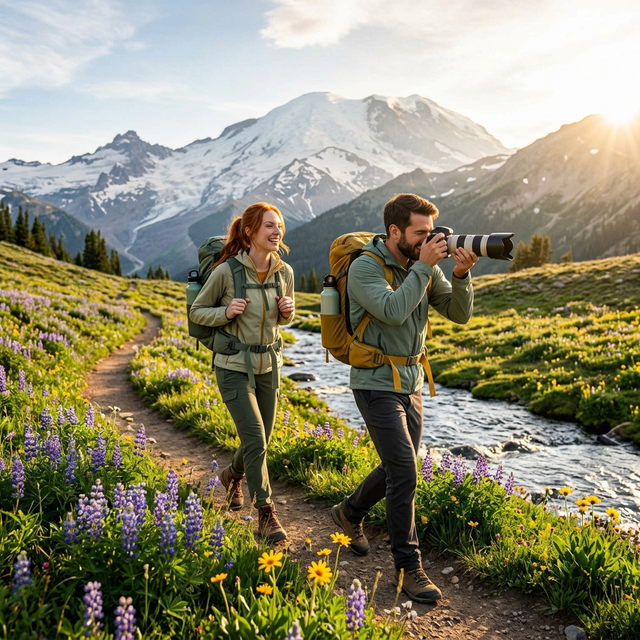
By Val & Chip | Updated May 7, 2025
Why "Sustainable" Isn't a Dirty Word — It's a Superpower
We'll be honest: when we first started hearing "sustainable travel" thrown around, Chip rolled his eyes. "Sounds like code for 'no fun allowed,'" he said. And look — if your version of sustainability means staring at a wall in a windowless hostel eating unseasoned lentils, we'd roll our eyes too.
But that's not what this is. After years of road-tripping from Route 66's neon-lit diners to hidden state park gems, we've learned that sustainable travel actually makes everything better. You see more, spend smarter, connect deeper, and leave every place a little better than you found it.
These eight hacks aren't theoretical. They're battle-tested on hundreds of adventures. Here's the playbook.
Hack #1: Ditch the Disposable Mindset
Every single-use water bottle, coffee cup, and plastic bag you use on a trip ends up somewhere — usually littering the very places you came to admire. We've seen trail heads buried in plastic. It's heartbreaking.
Our move: We carry a YETI Rambler everywhere. It keeps water ice-cold for hours in desert heat, and hot chocolate warm on mountain mornings. One bottle, used daily, replaces literally hundreds of disposable ones per year.
Hack #2: Learn the Language of Respect
You don't need to be fluent. You need "hello," "thank you," "please," and "goodbye" in the local language. That's four words. Four words that transform how people look at you — from "tourist" to "guest."
Our move: Val spends 15 minutes on Babbel before every international trip learning the essential phrases. The reactions we get? Priceless. Shopkeepers light up. Guides share secret spots. Doors literally open.
Hack #3: Use Less Water & Power (It Adds Up Fast)
Shorter showers. Lights off when you leave. Towels reused. It sounds small, but multiply it across every traveler at every lodge, and you're talking about massive resource savings — especially in areas where water is trucked in or electricity comes from diesel generators.
Our move: We wrote a whole post on this — check out 5 Resource-Saving Travel Moves We Swear By for the deep dive.
Hack #4: Give Wildlife the Space They Deserve
Chip has a rule: "If an animal changes its behavior because of you, you're too close." No exceptions. We've seen tourists chase bison in Yellowstone, crowd sea turtles on beaches, and hand-feed bears. It never ends well.
Our move: Always use a zoom lens — never your feet — to get closer. Stay on marked trails. Never feed wildlife. The moment you see an animal react to your presence, back away. Invest in quality binoculars from Sportsman's Warehouse and you'll see more than the crowd-pushers ever will.
Download our FREE Ultimate Camping Checklist!
Hack #5: Spend Local, Impact Big
Your travel dollars are powerful. Spending them at chain restaurants and mega-hotels? That money leaves the community. Dropping them at the family-run cafe, the local guide, the artisan market? That money builds schools and keeps traditions alive.
Our move: We make it a rule to eat at least two meals a day at locally-owned spots. We buy souvenirs directly from makers. And we always tip generously — it goes further than you think in small communities.
Hack #6: Find Genuinely Green Stays (Not Greenwashed Ones)
Every hotel claims to be "eco-friendly" these days. Most are lying. A towel reuse sign isn't sustainability — it's a cost-cutting measure they wrapped in a leaf icon.
Our move: Look for GSTC-accredited certifications. Read recent reviews that mention actual sustainability practices (solar power, composting, local sourcing). Book through trusted platforms like Trip.com that make it easy to filter for genuine eco-stays.
Hack #7: Pack Light, Travel Free
Val used to be a chronic over-packer. A 65-liter bag for a weekend trip? Classic Val. Then she tried a 30-liter bag for a two-week road trip and never looked back. Less stuff = less fuel burned transporting it, less hassle at airports, and more freedom to move.
Our move: Multi-use items only. A quick-dry towel that doubles as a blanket. A jacket that packs into its own pocket. Shoes that work for hiking AND dinner. Every item earns its spot.
Get our FREE Sustainable Explorer Checklist!
Hack #8: Choose Greener Rides
This is where it gets exciting. Walking, biking, and taking trains isn't just better for the planet — it's a fundamentally better way to experience a place. You hear, smell, and feel things you miss at 70 mph in an SUV.
Our move: When we're exploring a town, our Velowave E-Bike is our secret weapon. Zero emissions, plenty of power for hills, and Chip's knees don't complain. For longer distances, trains beat short-haul flights every time. We covered this in detail in our E-Bike Range podcast episode.
The Playbook, Summarized
These eight hacks aren't about sacrifice — they're about optimization. Every single one makes your trip richer, more authentic, and more memorable. They're the difference between being a tourist (someone who visits) and a traveler (someone who connects).
And for those keeping our trip insurance in mind — especially for more adventurous itineraries — we genuinely recommend VisitorsCoverage Travel Insurance. Peace of mind that costs less than a fancy dinner.
🌿 Val & Chip's Sustainable Travel Kit
- ❄️ YETI Rambler — Replace hundreds of disposable bottles
- 🗣️ Babbel — Learn essential phrases in minutes
- 🏕️ Sportsman's Warehouse — Quality binoculars & wildlife-safe gear
- 🚲 Velowave E-Bikes — Zero-emission town exploring
- ☀️ SOS Solar Phone Charger — Off-grid power from sunlight
- ✈️ Trip.com — Book verified eco-friendly stays
- 🛡️ VisitorsCoverage — Travel insurance for adventurous itineraries
🎧 Want the deep dives? Check out our Eco-Explorer's Haven Podcast!
Disclaimers:
AI Disclaimer: This blog post was created with the assistance of AI tools for brainstorming and structuring content. All ideas and recommendations reflect Val & Chip's genuine travel experiences and have been reviewed and edited by humans.
Affiliate Disclaimer: This post contains affiliate links. If you click on a link and make a purchase, we may receive a small commission at no extra cost to you. This helps fund our mission to share sustainable, quirky travel stories!